FIBER OPTICS
What is it and how does it work?
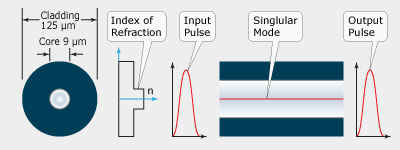
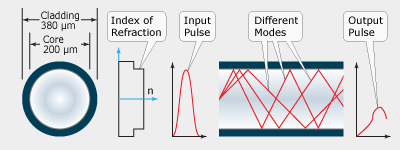
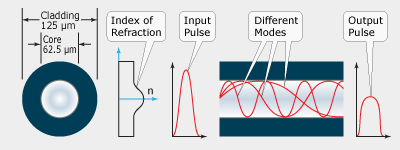
Light is transmitted through the core of a fiber optical cable by bouncing off the walls of the cladding by the principle of total internal reflection allowing the fiber to act as a light waveguide. Because the cladding does not absorb light from the core, signals can travel great distances with only slight losses occurring from impurities in the glass. Fiber cable can be made to support a single propagation path (single-mode fiber) or multiple propagation paths (multi-mode fiber).
History
The birth of fiber optics dates back to the first demonstration of guiding light by refraction by Daniel Colladon and Jacques Babinet in the early 1840s France. The first practical applications of optical fiber appeared early last century when it was used for internal illumination during dentistry procedures. It was not until 1965 though that fiber finally hit its potential when Charles K. Kao [Factoid: Nobel Prize recipient in Physics 2009] and George A. Hockham, of the firm Standard Telephones and Cables, proposed that optical fiber could be effectively used for telecommunications by removing impurities within the optical glass to reduce the signal attenuation to below the threshold of 20 dB/km. By the mid-seventies, the doped optical glass produced by Corning yielded attenuation levels of just 4 dB/km.

Multi-mode Optical Fiber Detail
The first generation of deployed fiber came about in 1977 using GaAs semiconductor lasers to achieve a bit rate of 45 Mbps with repeater spacing of up to 10 km. A major milestone for fiber occurred in 1988 when the first transatlantic telephone cable to use optical fiber, the TAT-8, went into operation. Since then, the use of fiber has exploded to encompass virtually all long-distance telecommunications within the United States. In fact, the Internet as we know it today would not have been possible without a massive fiber-optic infrastructure to carry the burden of such high data through fare.

Optical Fiber Construction
The optical fiber cable is constructed by two dielectric layers: a core which is surrounded by cladding. In order to confine the light signal within the core, the core's refractive index must be greater than the cladding's. The physical boundary between the core and cladding is an abrupt change in step-index fiber and a gradual change for graded-index fiber. Both the core and cladding are fabricated from silica glass which has a typical refractive index of 1.5 [Factoid: The refractive indexes of the core and cladding typically differ by a mere 1%]. Surrounding the cladding is a buffer coating comprised of UV-cured urethane acrylate composite. Finally, a cable jacket layer acts as the last form of protection for the fiber cable from the environment.

Civilian Fiber Optic Jacket Color Chart
Fiber Type Jacket Color
Single-mode Yellow
Multi-mode 62.5/125 μm (OM1) Orange
Multi-mode 50/125 μm (OM2) Orange
Multi-mode 50/125 μm "laser optimized" 10 Gbps (OM3) Aqua
Fiber Optics vs Copper Based Signal Transmission
Bandwidth
Fiber optics offer a great many benefits over traditional copper-based signal transmission which has in turn led to their popularity with the telecommunications industry. One main benefit of optical fiber is its massive bandwidth. In fact, fiber can often carry so much data that it would take thousands of metal-based wires to replace one single high-bandwidth fiber optic wire.
Low Signal Loss
Another benefit of fiber cable is its very low signal loss, which allows for great distances between terminations or in-line signal repeaters. While copper cabling typically can run only about a mile before needing amplification, it is not uncommon for fiber optic cable to run 60 miles before signal boosting or processing. One reason for fiber's low losses stems from its lack of electrical conductivity which also means that it produces zero crosstalk between parallel runs of cable over great distances.
Immunity EMI/RFI
As fiber cables are all-dielectric, they are effectively immune to RFI/EMI. This means that fiber cabling can be run in areas of high interference such near power lines, utility lines, and transmission antennas. Furthermore, fiber cables are ideal for areas where lightning strikes are commonplace. In fact, fiber is even immune to nuclear electromagnetic pulses though it can be damaged by a blast's alpha and beta particle emission.
Other Advantages
Because fiber cable is lighter than metal-based wires, it is ideal for use on aircraft where weight is always a concern. Safety too is another hallmark of fiber as its inability to spark due to potential differences make it useful in flammable environments. Lastly, fiber is very difficult to signal tap without disrupting the original transmission which makes it a very secure data transmission method.
Fiber Types
Step-Index Multi-mode Fiber
Graded-Index Multi-mode Fiber
Step-Index Single-mode Fiber